Product category
Pulse generators
Whether you need precise timing for trigger and synchronisation tasks or a precisely controlled current pulse for your test specimen: Schulz-Electronic stocks pulse generators and impulse generators from Quantum Composers for virtually any application requiring reproducible, time-accurate signals. Whether you need a pulse-delay signal generator or a current pulse generator with true power output – our team will advise you, independently of any specific manufacturer, on the appropriate resolution, number of channels and output type.
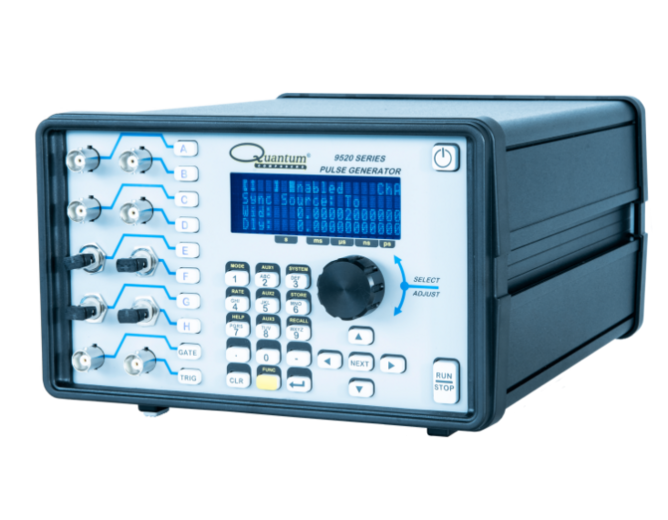
The right pulse generator for your application
A pulse generator produces pulses with precisely defined timing, either as a pure control signal or as an actual current pulse that directly supplies a test object. By utilising multiple channels and the adjustable time delay between them – down to the picosecond range – it enables the most precise timing of various active components in relation to one another.
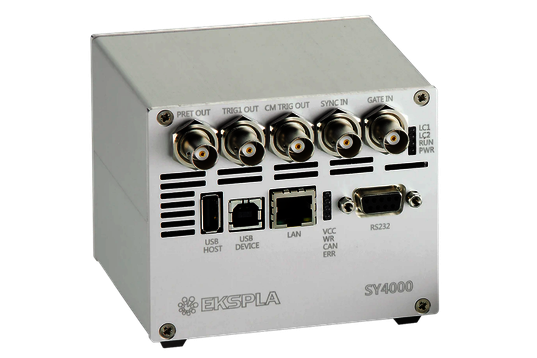
Signal pulsers for timing, triggering and synchronisation
As a programmable pulse-delay generator, this type of device outputs square-wave signals at TTL or CMOS levels rather than power. With multiple independent channels, you can precisely synchronise lasers, cameras, detectors or other measuring instruments with one another, with resolutions down to the picosecond range and jitter values that reliably safeguard even the most demanding timing chains in research and development.
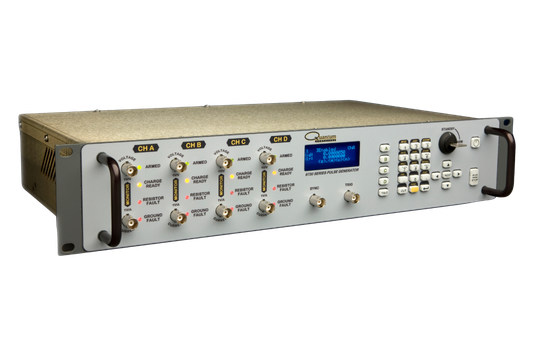
Power Pulser: Pulsed power supply for precise current pulses
If, on the other hand, you do not require a trigger but need to apply actual energy to the test specimen, the Power Pulser is the right choice. It outputs a precisely controlled current pulse with adjustable amplitude, pulse width and repetition rate, supplemented by safety functions for operation with a real load. This class of equipment is usually referred to as a pulse power supply or pulse current source because, unlike a pure signal generator, it actually delivers power rather than merely transmitting a signal.
What to look out for when making your choice
| Number of channels | From 2 channels for simple trigger tasks up to 36 independent channels for complex multi-event synchronisation. |
| Time resolution and jitter | For high-precision timing, fine resolution (up to 250 ps) combined with low channel-to-channel jitter (less than 50 ps) is essential. |
| Output type | Pure TTL/CMOS square-wave signal for triggering and control purposes, or an actual current pulse (power pulse) with adjustable amplitude for directly powering a test specimen. |
| Frequency range | Depending on the series, from a few MHz up to 20 MHz repetition rate, suitable for high-speed trigger or multiplexing applications. |
| Pulse width and delay | Adjustable pulse widths and delay times. For power pulsers, these can also be set in seconds to produce longer, defined current pulses. |
| Trigger and gate inputs | These enable external synchronisation with other devices in the test setup. |
| Safety features | Relevant for power pulsers: key switches and electrical and software interlocks to ensure safe operation with live current pulses. |
| Design and interfaces | From benchtop laboratory instruments to 19-inch rack-mount modules, connected via RS232, USB, Ethernet or GPIB. |
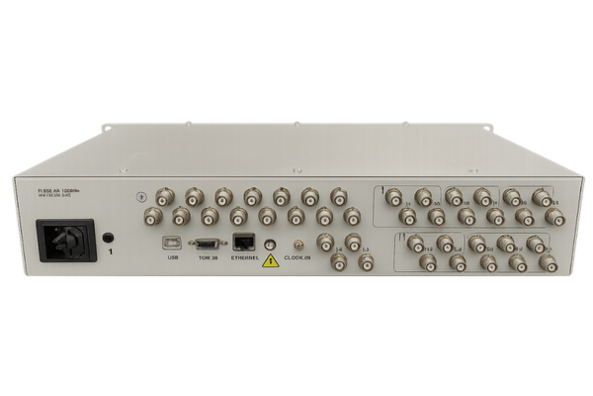
Pulse generators in your application
We use pulse generators in several test areas:
Photonics & lasers: As pulse-delay generators, they synchronise, for example, seed drivers, pump drivers, AOMs and measurement equipment to ensure precise timing chains.
Component Testing / EOL: In automated test benches, pulse-delay generators ensure the precise synchronisation of test sequences.
Do you know what you need, but can’t find the right product?
Save yourself the effort of a time-consuming search: our experts will quickly find the solution that’s exactly right for your application.
Request a consultation now
Pulse generators from Quantum Composers
For current pulse and pulse delay generators, we rely on leading manufacturers such as Quantum Composers for precision pulse generators and laser systems in research and development, and Ekspla for extremely compact, high-precision OEM delay generators designed specifically for laser systems.

Schulz-Electronic: Your partner for pulse generators
For over 50 years, we have been helping customers in industry and research to select precise timing and pulse solutions.
Manufacturer-independent advice: With over 1000 products from more than 16 manufacturers in our portfolio, we recommend the solution that best suits your application.
Support throughout the entire life cycle: from test equipment before the project begins, through on-site training, to after-sales repair services – we are by your side even whilst your equipment is in operation.
Certified quality: Our ISO 9001-compliant quality management system, supplemented by TÜV certification, ensures the reliability of every solution we deliver.
Frequently asked questions about pulse generators
A simple square-wave generator usually produces a single, repeating signal on one channel. A pulse generator, such as those in the Quantum Composers range, on the other hand, offers several independent channels, each of which can be individually programmed for pulse width, delay and rate. This allows multiple events to be precisely synchronised with one another, rather than simply generating a single signal.
Jitter describes the temporal variation between two consecutive pulses or between the channels of a device. The lower this value, the more precisely the timing is repeated. In the Quantum Composers series, the channel-to-channel jitter ranges from under 50 to 500 picoseconds, depending on the model. For applications in which several events (e.g. a laser pulse and a camera trigger) must be precisely synchronised with one another, this value directly determines the reproducibility of your measurement results.
A signal pulser provides a control signal at TTL or CMOS levels, which is used to trigger or synchronise other devices. It does not supply power to the device under test itself. A pulse power supply (power pulser), on the other hand, directly delivers a metered current pulse to the device under test – such as a diode or a semiconductor component – and thus supplies the power for the test itself, rather than merely providing a control signal.
Please discuss your requirements with us
Whether it’s a data sheet, technical specifications or a specific requirement: our experts are familiar with the full range of pulse generators available on the market and will work with you to find the device that suits the number of channels, timing requirements and output type of your application.
Request a consultation now